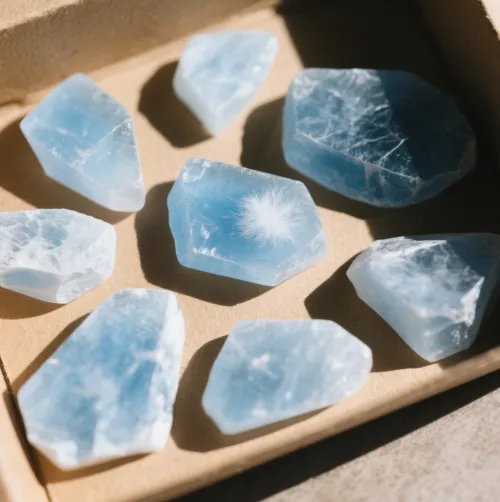
Where Do You Find Kyanite
Ever traced your fingers over rock formations during a hike and wondered what stories they hold? Those bands of shimmering blue you might've glimpsed—could they be nature's own gemstones whispering tales of earth's transformation? Well, maybe not exactly whispering, but certainly revealing something profound about how pressure and time craft beauty. That fleeting moment when sunlight catches an unexpected azure sparkle in a boulder—haven't you felt that pull to look closer? It's in those raw, unscripted encounters that we often find the most captivating treasures, and today we're unraveling the journey of one such marvel: Kyanite.
This passage will be explored at:
- Primary Geological Occurrences
- Identifying Rock Formations
- Extraction Methodology
- Field Identification Techniques
- Handling and Preservation Practices
- Industrial Utility and Value Factors
- Structural Properties and Composition
Primary Geological Occurrences
Picture yourself on a windswept mountainside where ancient forces reshaped the land—this is where kyanite’s story begins. These radiant blues aren't scattered randomly; they emerge through a perfect alignment of pressure and mineral-rich narratives deep within our planet.
Here's the magic: kyanite tends to form predominantly in metamorphic rock formations, born from intense pressure that transforms ordinary materials into something extraordinary. And in those aluminum-rich sediments compressed over eons? That's where the alchemy happens. At some point, during regional transformations of earth's layers, conditions align to crystallize this mineral—almost like the earth deciding to punctuate its history with vivid blue exclamation points. Isn't it astonishing how beauty arises from tension?
Imagine standing before rock faces layered like pages in a geological diary—how do you spot which chapters hold the blue treasures? Those slate-gray schists and shimmering mica bands might guard more than they reveal at first glance.
The thing is, kyanite often appears alongside trusted geological companions—garnet's rich reds or staurolite's cruciform patterns dancing nearby. It favors quartz-rich bands in schist sequences, almost as if preferring contrast to showcase its vibrant blues. But here's what makes finding it special: the journey. When you finally see light refracting off those planar surfaces within the rock matrix, it feels less like discovery and more like receiving a gift the earth kept protected for millennia.
Ever watched miners work with mindful precision, separating stone from stone? There’s wisdom in their selective approach—a lesson in respecting what the earth offers rather than demanding more.
Surface mining reigns as the primary technique in kyanite retrieval, partly because nature often places these treasures within reach of human hands. After extraction, what follows? A cascade of careful choices. Workers isolate specimens through gravity-based methods that honor each mineral's unique density. But the real art unfolds during manual sorting—those patient moments when fingers discern crystal from matrix. It's tactile poetry: separating without force, lifting without fracturing. Doesn’t every precious thing in life deserve such attentive handling?
Field Identification Techniques
Holding a potential kyanite sample in your palm, light glinting off its facets—can you feel that childlike wonder rising? Field identification blends science with intuition, where every clue matters.
Reading Color's Whisper
The blues—oh, those mesmerizing blues ranging from pale cyan to deep sapphire—offer our first visual signature. But true observation means seeing beyond hues alone. Notice what happens when sunlight angles change. Kyanite may reveal its hidden language of light through distinct pleochroism. Rotate it gently: colorless whispers shift to cerulean, then deepen to twilight shades.
Decoding Crystal Architecture
Sometimes broken edges speak loudest. Those unmistakable blade-shaped formations serve as nature's fingerprint. And the hardness? Well, the thing is kyanite plays tricks—it shows variable hardness between 4.5 to 7 on Mohs scale depending on crystal direction. That's not inconsistency—it’s character.
Patterns Holding Stories
Look closer still. Color zoning across a specimen can map its geological journey like rings on ancient trees. These variations aren’t flaws; they're diaries written in mineral deposition.
Handling and Preservation Practices
So you’ve found a glistening piece—how do you honor its journey? Preservation isn't about confinement; it's safeguarding essence.
First, a gentle truth: unlike us, kyanite prefers stability. Avoid placing specimens close to heaters or windows where temperature fluctuations exceed 250°C or ultraviolet rays cause fading over years. Instead, cushion them with soft materials to prevent cleavage plane fractures—those natural lines where stress concentrates. Think of storage as creating a sanctuary: dark, room-temperature spaces where specimens rest without touching. After all, this isn't just mineral care—it’s reverence for resilience formed under pressure.
Your Mineral Moment
Today might hold unexpected encounters—along a trail, near a construction site, even in garden gravel. Will you pause? When curiosity nudges you toward an unusual blue glint, why not gently pick it up? Examine its edges, note the color play under sunlight. That moment isn’t coincidence; it’s the universe offering a tactile reminder of nature's artistry. Share your discovery. Someone nearby might need that spark of wonder.
Industrial Utility and Value Factors
Beyond beauty lies brilliance—kyanite serves humanity in quietly powerful ways. Its application in refractories? That’s where remarkable thermal stability shines, literally enabling industries to reach extreme temperatures safely.
Valuation weaves multiple threads: crystal clarity and saturation matter profoundly, but so does structural integrity—how unbroken and coherent the formations remain. Yet here’s what industrial stories rarely reveal: every crucible lining using crushed kyanite carries within it millennia of earthly transformation. Isn’t it humbling how nature’s patient alchemy supports our modern endeavors?
Structural Properties and Composition
That blue fragment you cradle—what makes it fundamentally itself? Composition unveils poetry written in elemental language.
Chemically, kyanite corresponds to aluminum silicate—an elegant combination where aluminum and oxygen bind in precise ratio. But atomic structure sings louder than formulas. When scientists confirm patterns with x-ray diffraction, they're tracing crystalline lattices that organized under pressure into stunning symmetry. Here’s what speaks to the heart: this mineral forms blades yet withstands pressure; shows variable hardness yet maintains integrity—reminding us that flexibility and strength coexist beautifully.