# 完整HTML输出
Where Does Blue Kyanite Come From
Have you ever held a piece of blue kyanite and felt its cool, smooth surface? There's something about that translucent blue - like captured sky or deep ocean waters frozen in time - that makes you wonder: how did Earth create such stunning beauty? Well, the answer is far more fascinating than it seems at first glance. Blue kyanite feels special because it is special, formed through a kind of geological alchemy that transforms ordinary minerals into these extraordinary gemstones under extreme pressures.
What if I told you that the very stone in your palm has journeyed through mountain-forming catastrophes and survived planetary forces that would crush most materials? Maybe you've sensed that ancient energy already—the way it seems to channel clarity and focus. Today we'll explore these mysteries together, discovering why this remarkable crystal appears in selective corners of our planet but avoids others entirely.
This passage will be explored at:
- Geological Formation Process
- Global Mining Locations
- Identifying Natural Characteristics
- Industrial and Creative Applications
- Proper Handling and Preservation
- Long-Term Value Considerations
- Geological Science Insights
Imagine this: deep beneath young mountain ranges, where unimaginable pressures mold the earth like clay, blue crystals emerge through regional metamorphism. Over millions of years, aluminum-rich sedimentary rocks get compressed and baked at just the right temperatures—around 300-700°C. It’s not unlike how diamonds form, really, except here we’re witnessing Earth’s gentler yet equally powerful artistry.
The magic happens within specific pressure corridors between 4 to 10 kilobars. At some point, chemical bonds start rearranging themselves under stress, kind of like how challenging life events push us to grow differently. Trace elements of chromium or titanium sometimes join the party, tinting the crystals with those mesmerizing blue hues we love. Why not consider these formations as Earth’s way of showing us what beauty can arise under pressure?
Global Mining Locations
Picture Brazilian miners navigating the mountains of Minas Gerais at sunrise—that’s where the most significant deposits reveal themselves within ancient schist and gneiss formations. It’s rugged terrain, with veins hiding like buried rivers. The extraction itself is surprisingly delicate work—open-pit techniques requiring precise geological surveys, since one wrong move might shatter unstable crystal clusters.
But Brazil isn’t the only storyteller here. Smaller treasure troves exist in Switzerland’s Alps and Nepal’s Himalayan foothills. These deposits often emerge near subduction zones where continental plates collide—which makes me wonder: are the earth’s most powerful collisions always destructive? Or do they sometimes create profound beauty? Every time you hold Brazilian or Nepali kyanite, you’re holding fragments of continental transformation.
Identifying Natural Characteristics
Now here’s where things get visually enchanting: genuine natural specimens display bladed crystal structures with varying hardness depending on how you test them. This curious property—anisotropy—means crystals exhibit different durability when rubbed or scratched in different directions. It’s a gentle reminder that appearances aren’t everything—sometimes inner structures determine strength.
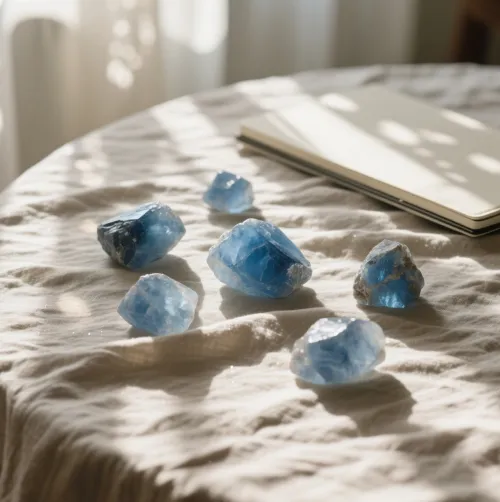
Notice how many stones exhibit color zoning ranging from pale blue to ultramarine? Such gradients develop because trace elements distribute unevenly during formation—and they’re nature’s signature that the material hasn’t been tampered with. Have you ever noticed those unique flashes in your kyanite? Turn it slowly under light and observe pleochroism causing apparent color shifts between blue and almost colorless. It’s like watching your crystal breathe.
Industrial and Creative Applications
Beyond their emotional resonance, these minerals have surprisingly practical sides. Industrial applications leverage the mineral’s heat endurance—resisting temperatures up to 1,300°C—to stabilize kiln-fired items like spark plugs and thermocouple tubes. There’s poetry here: minerals formed under immense heat now serve us in high-heat environments.
For gemstone lovers, skilled faceting maximizes light reflection from those natural cleavage planes. It demands specialized expertise—cutters must intuitively understand crystalline orientations to unleash the inner brilliance. The transformation from rough stone to polished gem mirrors our own journey back to our core truths. Isn’t it humbling how an earth-born mineral can bridge practical craftsmanship with metaphysical beauty?
Proper Handling and Preservation
These crystals need attentive stewardship—they thrive with thoughtful handling. With moderate Mohs hardness between 4.5-7, they should rest in softly lined compartments away from harder companion stones to avoid surface scuffing. Think of it as honoring the gentle spirit within the stone.
When cleansing becomes necessary, lukewarm water paired with pH-neutral detergent works beautifully. Avoid anything harsh! Steam and ultrasonic cleaners are especially risky—ultrasonic vibrations can trigger fractures along internal stress points. Isn’t it fascinating how this mirrors human vulnerabilities? Even resilient treasures need protection in vulnerable places.
Long-Term Value Considerations
For collectors, several factors influence investment potential—hue saturation deepens valuation dramatically, while clarity and crystalline completeness contribute heavily to official grading scales. But authentic worth goes beyond aesthetics; ethical sourcing with traceable documentation is becoming increasingly significant in today’s conscious markets.
What’s truly intriguing? Specimens from depleted mines often appreciate with time, reminding us that rarity often enhances meaning. Have you ever considered that your kyanite piece connects you to a geological heritage now inaccessible? That connection transcends monetary value—it’s a tangible link to landscapes forever changed.
Earth’s Gentle Message
Next time blue kyanite crosses your path, hold it thoughtfully. Notice how its layered formation parallels your own resilience—every pressure endured has created unique beauty within you. Why not carry it as a reminder that challenges cultivate depths unseen?
Geological Science Insights
Modern geology reveals how kyanite’s transformation occurs only when pressure/temperature conditions align precisely—metamorphic gradients between 4-10 kilobars create the stability required for crystallization. Field studies show these minerals typically cluster in aluminum-rich zones in mountain belts, forming alongside garnets and quartz during continent-building episodes.
Research on chromium and titanium trace impurities keeps clarifying blue color variations—some deposits owe their intense blues to localized chromium interactions during metamorphic heating. Every time science unpacks more of kyanite’s story, we glimpse Earth’s quiet wisdom: creating extraordinary results through patient, perfect timing.
So there we stand—humbly holding fragments of ancient mountains. Doesn’t it feel like geologic time whispering that everything unfolds when conditions align? Perhaps your kyanite arrived at precisely your moment of readiness.