Where Is Kyanite
Have you ever held a piece of kyanite? That stunning shard of blue—sometimes with streaks of white or green—may feel like holding solidified moonlight. Well, maybe not exactly… but doesn’t it make you wonder how something so mesmerizing could form naturally? What makes those radiant crystals emerge only in specific corners of our planet, like elusive blue whispers in stone? We’ll uncover how Earth’s hidden poetry surfaces through minerals. You’ll discover kyanite isn’t just scattered randomly—where it forms speaks of intricate geological conditions, almost like the Earth’s intentional brushstrokes. Let’s trace its footprints together, exploring locations deep within mountain chains and ancient formations.
This passage will be explored at:
- Primary Global Sources
- Geological Formation Conditions
- Extraction and Processing Techniques
- Visual Identification Markers
- Storage and Conservation Practices
- Industrial Value and Supply Cycles
- Common Myths Clarified
Primary Global Sources
Picture standing at Brazil’s Minas Gerais—miners carefully extract shimmering blue layers while quartz veins glisten nearby. This region isn’t alone; kyanite appears where Earth’s metamorphic processes align like puzzle pieces. Travel north to Virginia’s Blue Ridge Mountains, where century-old deposits still yield sky-blue treasures.
Kyanite deposits tend to occur within aluminum-rich metamorphic belts worldwide, with large-scale sources concentrated in Brazil, Switzerland, Russia, and parts of North America. But why these locations? The mineral typically develops where quartz and garnet are present. It’s like nature’s fingerprint—specific, repeating patterns reveal where pressure transformed rock into something spectacular under the surface. Have you considered how these formations mirror resilience? Just as Earth requires certain pressures to unveil beauty, perhaps we too unfold in unexpected ways when life compresses us.
Imagine the slow dance 12 miles below Earth’s crust: temperatures between 400-600°C—about as hot as volcanic magma—and pressures comparable to 2,000 elephants standing on a coffee table! That’s where kyanite crystallizes over millennia, hidden from human eyes. These formations aren’t accidental; they emerge under specific geothermal conditions—neither too extreme nor too mild—in what scientists call "Goldilocks zones" for aluminum-rich rocks.
This mineral develops in association with quartz, garnet, or staurolite veins only when optimal conditions align. The key? Medium-pressure environments. Without precise combinations of heat and compression, those bladed crystals wouldn’t form. Isn’t it amazing how Earth’s artistry flows through invisible forces? And perhaps—just perhaps—life’s pressures, too, shape us into more radiant forms when we trust the process.
Extraction and Processing Techniques
Surface Mining Operations
Miners survey aluminum-rich metamorphic regions to identify potential veins, followed by controlled blasting to avoid damaging the delicate crystals. Surface extraction avoids risky tunneling while allowing access to shallow deposits. At some point, raw rocks undergo gravity separation—where kyanite is sorted by density using simple tools like shaking tables. It’s a process honoring the mineral’s natural structure rather than overpowering it.
Refining Methods
Processing techniques might include electrostatic separation to isolate non-conductive kyanite from other minerals. Each step gently liberates the blue bladed crystals from surrounding rock—no harsh chemicals required. This thoughtful extraction ensures the mineral retains its inherent thermal stability properties, which give it such value in industrial applications.
Visual Identification Markers
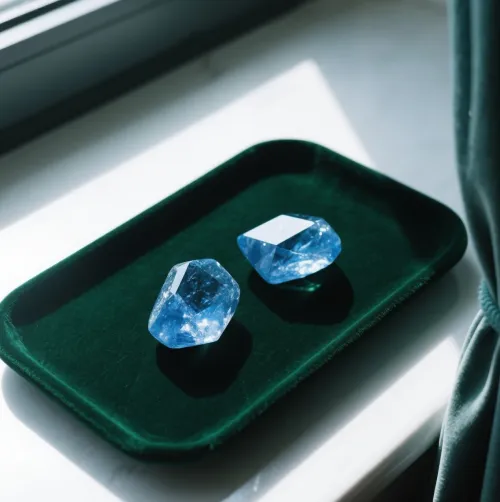
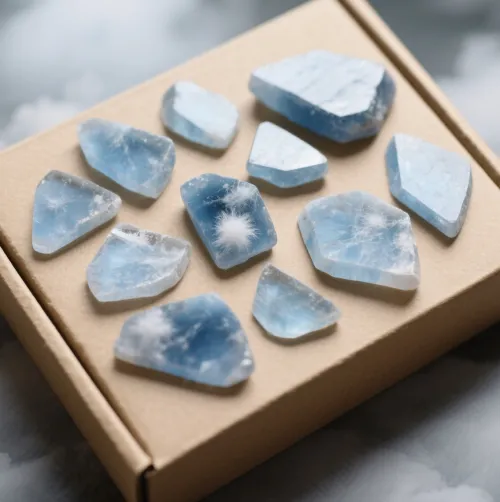
Spotting kyanite requires patience. Notice the elongated bladed formations resembling frosted glass sabers. Unlike many gems, its appearance changes dramatically under light—translucent in thinner edges but semi-opaque at thicker sections. The thing is, its beauty lives in subtle variations.
Kyanite’s distinctive blue comes from trace chromium or iron oxide—the greater the concentration, the deeper the shade. Its hardness varies between 4.5 and 7 on the Mohs scale depending on direction—scratch-testing it vertically yields different results from horizontal testing. Cleavage planes will show visible fracturing along one axis. Why does this matter? Because even seemingly rigid structures have different strengths based on orientation—reminding us that resilience isn’t always uniform.
Storage and Conservation Practices
To preserve kyanite’s luminosity, avoid placing it by sunlit windows—that vibrant blue whispers "protect me" against UV degradation. Instead, store pieces in humidity-controlled environments using silica packets in display cases. When handling, cradle your specimens like rare orchids rather than gripping tightly.
Conservation necessitates shielding from prolonged UV exposure to prevent dulling of its magical color. When cleaning, skip ultrasonic methods—opt for soft brushes and lukewarm water to preserve surface integrity. Notice how gentle care maintains material stability? Think how tenderness might guard your own inner light too. Regular maintenance isn’t tedium—it’s an act of honoring natural beauty day by day.
Crystal Wisdom: Endurance in Formation
Kyanite’s journey teaches us about transformation under pressure. Just as heat and compression deep within metamorphic rocks create this magnificent mineral, your life’s pressures forge unseen strengths. Are you ignoring your capacity to become something extraordinary? Remember: stones that endure the deepest heat emerge as light-bearing treasures.
Industrial Value and Supply Cycles
In ceramics factories, kyanite dust is blended into super-refractory molds. These molds withstand furnace temperatures that would melt ordinary materials—all thanks to the mineral’s incredible thermal stability enabling manufacturing breakthroughs. Electrical engineers value it too, using resistant grades as natural insulators in high-end components.
Market valuation hinges on three factors—vein purity, crystal size, and chromatic depth—creating fascinating price variations. Supply cycles constantly fluctuate though, influenced by changing regional mining policies worldwide. But there’s rhythm within these waves—periods of scarcity heightening appreciation, followed by discoveries celebrating resilience. Material stability supports long-term applications, affirming sustainability when we handle resources mindfully. Have you noticed how cycles teach patience? Sometimes abundance rests right beneath the next turn.
Common Myths Clarified
Myth #1: Kyanite's blue color remains uniform regardless of lighting conditions
Actually, transparency levels shift in changing light. Thick sections appear semi-opaque while thin edges glow translucent. Its beauty lives in adaptation!
Myth #2: All blue kyanite sources are exhaustively mapped and mined
Fresh deposits emerge unexpectedly—geologists recently identified promising veins in East Africa, reminding us Earth’s secrets always exceed human knowledge.
Myth #3: Hardness testing alone confirms kyanite authenticity
Given its directional variance—4.5 along one axis, 7 along another—sole reliance on scratch tests is misleading. Trust requires multiple signals working together. And maybe that’s true elsewhere too.