What Food Products Contain Kyanite
Ever found yourself scanning ingredient labels and wondering — "could kyanite be in here?" Maybe it sounds exotic enough to belong in some superfood trend. Well, let's pause for a moment. If you've had that tiny whisper of curiosity, here's something fascinating: while minerals weave through our world in unexpected ways, kyanite is never one you'll find in your pantry. Why? Because this radiant blue crystal prefers the fires of industry over dinner plates. Its journey takes it through blast furnaces and kilns, not snack bars or supplements. But don't you wonder how rocks become invisible allies in manufacturing?
This passage will be explored at:
Absence in Food Items
Imagine unpacking groceries and spotting an electric-blue speck in your rice — that's not kyanite calling to you. This isn't some cosmic mystery or oversight. At its heart, kyanite belongs to aluminum silicate minerals that form deep beneath mountains, worlds away from fruit orchards or spice fields.
The very idea of it landing in your smoothie? Think of this instead: when we speak of "non-food-grade" minerals like this one, it's about protecting you. These blue strands are forged through Earth's pressures, not designed to nourish bodies but to withstand industrial extremes. If it somehow touched food packaging? Regulatory systems catch it through safety certifications verifying its absence — a guardian you never see working tirelessly.
Industrial Applications Overview
Where kyanite truly dances is in places humans rarely glimpse — inside roaring kilns lining ceramic workshops, within furnace walls embracing molten metal. Picture workers crafting bricks that endure what would vaporize ordinary stone. Why? Those brilliant blue blades hold nature’s gift: the ability to expand differently along each axis. That means they brave thermal shocks that fracture other materials.
Ever held a ceramic mug that lasted decades? Thank kyanite transformed into mullite through heat. It locks durability into porcelain and refractories used everywhere from steel foundries to spacecraft shields. There’s poetry here — how Earth’s hidden gems become humanity’s thermal armor. Just imagine it: quiet stones whispering strength through fire, turning industrial dreams into tangible realities.
Identification of Kyanite Presence
Sometimes traces travel. Suppose flecks appear near raw materials in factories. Does that uninvited glitter spell trouble? First—don’t panic. Labs identify these mineral guests through unique crystal signatures under microscopes. Like cosmic fingerprints, X-ray diffraction maps their atomic lattice. That’s how industries spot contamination early — protecting processes and people.
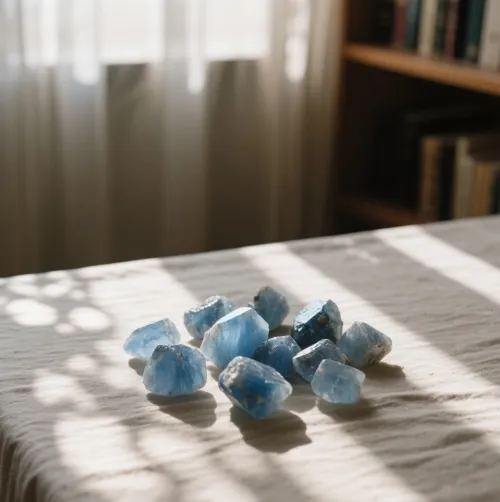
- Visual cues: Those bladed clusters resemble frost on stone but with deeper sapphire whispers — striking against surrounding rocks
- Testing tools: Beyond human eyes, techniques analyzing density or thermal response reveal what casual glances miss
So whether guarding factory floors or inspecting raw supplies, remember — the universe leaves patterns everywhere for us to follow.
Handling Safety Measures
Even Earth’s resilient stones need gentle understanding. Workers crafting kyanite-based materials know this truth: every fragment carries potential breath hazards if air turns dusty. That airborne dance requires harmony with proper protocols — ventilated spaces singing fresh air into workshops.
Dust Containment Rituals
Systems catching particles before they rise — misty curtains and vacuum shields partnering to shield lungs
Personal Armor
Not medieval plate but modern shields — filtered respirators embracing faces during processing
Soundless Allies
Routine screenings ensuring every worker moves safely through mineral symphonies
Long-Term Industrial Benefits
Consider the bigger picture: when industry invests in kyanite-rich refractories, it’s planting seeds for sustainable forests. Furnaces lined with these materials endure years longer — slashing resource drains and frequent replacements. That means less mining, less waste, less disruption to Earth’s mantle.
The energy savings sing through power bills as kilns and reactors keep heat trapped where needed most. For steelmakers? It translates into consistent quality without constant shutdowns. What seems like small tweaks — upgrading materials to withstand thousands of cycles — echoes as quiet stewardship. And isn't that a testament to human creativity — using nature’s gifts to lighten our collective footprint?
A Moment to Breathe Deeply
Notice where minerals touch your life — through window glass, kitchen tiles, structural beams. When you see industrial symphonies as extensions of Earth’s rhythm, doesn't ordinary awareness become sacred?
Common Misconceptions Clarified
One persistent rumor: "Could kyanite powder accidentally slip into edible items?" Remember, it’s classified strictly as a non-food mineral. Rigorous audits inspect food-contact surfaces precisely because industries honor boundaries set by nature and science.
Another whisper: "If factories use it, residents nearby risk exposure." Factories managing airborne elements implement advanced filtration — turning potential risks into managed safety. Plus, kyanite’s density anchors it quickly unless aggressively disturbed. Sometimes fears fade when understanding dawns. Isn't clarity the purest form of reassurance?