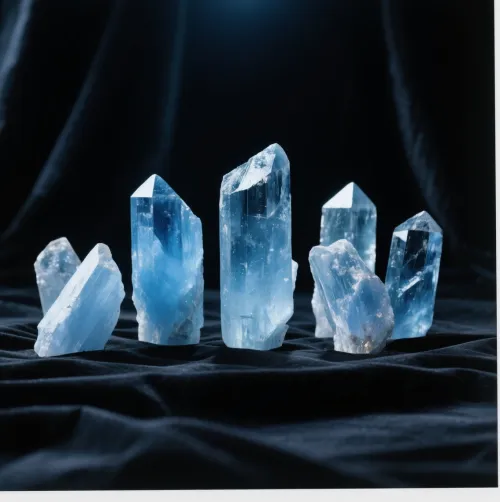
So you've stumbled upon a piece of kyanite, maybe in a friend's jewelry box or glittering in a museum case? That distinct, captivating blue or perhaps a striking green hue catches the eye immediately, sparking that little flicker of curiosity. What *is* it about this particular stone? On first glance, you might think sapphire, but look closer—it possesses this unique, almost fibrous look, layers stacked like nature's own blueprints. Ever held one? The feel is different... cool, substantial. There's a sense of depth there. Well, maybe not exactly mystical vibes, but certainly an intriguing presence. It makes you wonder: what gives kyanite its peculiar blend of beauty and toughness? Why do jewelers sometimes hesitate, while industrial folks get genuinely excited by a bucket of the stuff? Let's peel back those layers together and discover the quiet power held within this blade-like mineral. You might just find its story is as multifaceted as its crystals appear.
This passage will be explored at:
- Physical Characteristics
- Key Attributes
- Applications in Jewelry
- Industrial Functions
- Identifying Quality
- Care Recommendations
- Long-Term Considerations
- Additional Insights
Physical Characteristics
Imagine finding a stone that seems sculpted by nature itself into elegant, knife-edged formations. That's the signature look of kyanite, a visual whisper of its hidden structure. It’s the mineral world's layered blade, often
forming under tremendous pressure deep within
metamorphic rocks like schist or gneiss. This unique bladed crystal habit isn't just for show – it's a direct result of specific formation conditions. Pick one up, and you'll notice that characteristic layered texture, almost like tiny geological pages waiting to be read, hinting at how it transforms under immense heat and pressure deep within the earth. Isn’t it fascinating how hidden forces leave such visible marks?
Its color palette sings predominantly blues – ranging from delicate sky tones to deep, mesmerizing oceanic shades – but surprises pop up. You might encounter calming greens, stark whites, subtle grays, or even the rarer, grounding blacks. And the color isn’t static! Look from one angle, then another. With polarized light, its pleochroism comes alive – the visible hue can shift dramatically, revealing glimpses of its internal complexity just by a change in perspective. Add to this a surprising play in its very surface nature – its surface luster can shift remarkably from a bright, glassy (vitreous) sheen to something softer and pearlier, depending entirely on which crystal face you're viewing. It's as if with each glance, the stone offers a slightly different reflection of light, teaching us subtlety.
The Challenge of Hardness
Here’s where kyanite really stands apart, testing the tools and the craftsman’s touch. You can’t assume its resistance is the same in every direction. Run a point along one axis, and it might feel relatively easy to scratch – that’s the softer direction, rating around 4.5 on the Mohs scale. But turn your tool sideways? Suddenly, the same stone becomes much tougher, resisting up to a respectable 7. This
variable hardness depending on crystal direction is a fundamental characteristic, a signature trait that requires immense respect and understanding during any processing. Imagine trying to carve it... The struggle literally changes direction. Doesn't that echo how life sometimes pushes back at unexpected angles? The important thing isn't the obstacle itself, but how you approach it—sometimes sideways gives more strength.
Key Attributes
Beyond its beauty or toughness lies a fascinating physicality you can literally feel in your hand. Pick up a significant specimen – it carries a distinct heft. Measuring its density reveals a specific gravity typically between 3.53 and 3.67 on average, placing it a step above quarts in weight-for-size. This dense nature speaks to its underlying composition. And how it plays with light isn't limited to color shifts; when you shine a light through a clear piece, it bends the rays in a way refraction index ranges are measurable between approximately 1.712 to 1.734 depending on the light's path through its internal structure. Interestingly, unlike many gems where clarity is prized, kyanite embraces a range of being, from perfectly see-through to mistily translucent or even entirely opaque.
Kyanite is defined by its inner geometry. The most crucial characteristic to understand is its directional nature – its anisotropy. The way its atoms are arranged means its properties aren't uniform. That difference in hardness depending on which way you push or scratch is just one visible sign. This core anisotropy influences everything – how it breaks, how it behaves under stress, even its heat resistance in certain directions. It holds within it inherent axes of strength and vulnerability. And then there’s the perfect cleavage. This isn't a flaw but a fundamental property: it possesses planes where the atomic bonds are inherently weaker. Finding a sharp knife-edge formation often reveals how it can split perfectly along one crystal axis with almost mirror-like smoothness if struck just right. It reminds us that even strength includes points of connection, places where understanding the structure lets light shine through.
Applications in Jewelry
Kyanite walks a unique line between captivating appeal... and posing a genuine challenge for someone crafting it into jewelry. Jewelers, drawn by its ethereal blues and natural elegance, quickly encounter its complexities. That stunning, almost otherworldly appearance? It draws the eye instantly. Designers appreciate its potential for unique, flowing pieces that celebrate its natural, elongated formations. But, and it's a significant 'but', every artisan who works with it soon discovers the need for immense patience and specialized knowledge. Have you ever tried fitting a unique puzzle piece? That’s what it's like.
The major hurdles stem directly from its physical essence. Its durability is profoundly affected by those prominent cleavage planes. Imagine trying to secure it firmly in a ring setting – any impact hitting just the wrong spot could cause it to split along that perfect cleavage, whispering of inherent structure over imposed form. This significantly impacts its suitability for high-impact settings, like rings worn daily or bracelets prone to knocks. Prong settings become a tightrope walk, needing to be secure yet gentle. Perhaps this mineral’s essence in jewelry isn’t brute resistance but delicate resonance—reminding us that some of the most beautiful things thrive with attentive care. Its variable hardness range adds another layer for the cutter – changing approaches during precise faceting based on crystal orientation. Is the reward worth such precise effort, such intimate knowledge? For many seeking unique, natural-statement jewelry representing calm strength, the answer remains a resounding yes. Think pendants near the heart, or earrings catching the light—places where it can shine while being sheltered. Why not let beauty that requires gentleness serve as a reminder to protect the gentle strength within ourselves?
Industrial Functions
While its beauty finds expression in adornment, kyanite finds its powerhouse calling in the heat and stress of industrial processes. Here, aesthetics play second fiddle to its phenomenal ability to stand up to extremes. Its core value lies in its role as a
refractory material – something built to withstand temperatures that would melt ordinary substances like iron. Think fiery furnaces, kilns firing ceramics, or glass-making crucibles. How does it manage this? It possesses an exceptional heat stability forged deep within metamorphic rocks.
This resilience isn't a happy accident but a product of its creation under tremendous heat and pressure. It’s this inherent heat stability which permits its utilization in ceramics and refractories operating at high temperatures. Crucibles and furnace linings made with kyanite powder last longer under intense thermal cycling. When incorporated into ceramics, it enhances their thermal shock resistance – stopping dinnerware or spark plugs from cracking with rapid temperature changes. That signature anisotropy actually becomes a tool, contributing to directional variations in its properties, like specialized wear resistance during industrial cutting applications. These synthetic alternatives exist for some demanding industrial uses, often aiming for cost or consistency, but they often struggle to perfectly replicate the distinct natural optical efficiency and resilience found uniquely in the natural mineral.
The Transformation: From Raw Mineral to Refractory
The journey from raw kyanite crystals to a furnace brick involves transformation. Mined rough is sorted then intensely heated, or calcined, around 1500°C. This key process isn't just about drying – it fundamentally alters the mineral's structure, converting metastable kyanite into stable, volume-expanded mullite (3Al₂O₃·2SiO₂). The expansion creates a porous, insulating structure that traps air, making the final refractory brick lighter and more insulating, while mullite itself boasts incredible fireproof strength. It’s a metamorphosis under heat, turning potential into enduring protection – a literal act of becoming stronger through transformation. Doesn’t facing challenges sometimes do the same for us?
Care Recommendations
Treating kyanite jewelry requires a gentle, mindful approach – think of it like caring for anything uniquely precious in life. Unlike diamonds content with abrasive scrubs or sapphires tolerant of steam, a piece with kyanite asks for softness. Those beautiful facets or raw surfaces hold inherent planes of connection, places where impact or chemical extremes can cause harm. Understanding this isn't a weakness, it's simply respecting its nature. The beauty lies in appreciating its individuality. Just as you wouldn’t rush the flow of water, caring for kyanite asks for a slower hand. Isn't that a little like how we should learn to treat our own sensitive parts? With care?
For routine maintenance, simplicity reigns supreme. Mix a drop of bland dish soap into lukewarm water. Dip a soft brush – think a clean, infant-sized toothbrush – and gently agitate the solution around the piece. Rinse thoroughly under lukewarm running water to remove any soap residue, then gently pat dry with a soft, lint-free cloth. That's often all it needs. Devices like ultrasonic cleaners pose a significant risk; their intense vibrations can reverberate through the stone, potentially causing fracture or worsening unseen cleavages; definitely skip the steam cleaner as well. And storage? Don't toss it loosely into a jumbled pile! Storage really does necessitate protective wrapping – a soft pouch or lined compartment separate from harder gems or abrasive objects is key to prevent scratches. Avoid exposure harsh chemicals like chlorine or strong acids; they might not dissolve it instantly, but exposure may degrade surface brilliance or dull vibrant coloration over time. See care not as chore, but as protecting the whispers of beauty—reminding us that sometimes gentle protection allows things to shine longer.
When in Doubt, Go Slow
If stubborn grime persists despite gentle cleaning, don’t force it. Seeking professional assistance from a jeweler experienced with kyanite gems is far safer than aggressive home methods. Remember, the goal is long-term preservation, not instant shine. Gentle care maintains its connection to the earth, its natural story intact. It’s a practice in patience, reflecting how careful attention often reveals deeper layers of resilience and beauty within ourselves.
Long-Term Considerations
Owning and appreciating kyanite, whether a fine jewel or a raw mineral specimen, is a commitment to understanding its journey through time. Like us all, it exists within the flow of the elements and responds to its environment. Recognizing its needs ensures its story continues beautifully. Think of it not just as an object, but as a piece of the earth's history you connect with now. How does that connection speak to your own place in the long-term journey?
Light and temperature are key players in its long-term presentation. While stable temperatures are ideal, sudden changes are more concerning than consistent warmth or mild cold. Those inherent cleavages and structural properties can be stressed by minimizing significant temperature extremes and rapid shifts is recommended. Bright sunlight, especially potent ultraviolet rays found in direct sunlight, deserves respect. Over years, strong long-term preservation involves reducing UV light exposure, which has the potential to subtly fade even vibrant blues or alter more sensitive hues in lighter stones. Displays away from sunny window sills are ideal. And its structural essence remains a core factor forever; any setting, whether simple or complex, needs periodic professional checks to ensure protective prongs haven't worn thin or settings grown loose – safeguarding against accidental impacts that could exploit its inherent nature. This mindful stewardship ensures the stone’s presence remains a connection to hidden depths.
Let the Stone Speak
Next time you hold your kyanite, try this simple noticing exercise: observe its temperature against your skin for a minute – cool, then warming. Notice any subtle variations in color depth under indoor vs. natural light. Does the texture feel different along the blade versus across it? These tiny sensory signals reconnect you to its unique physical story. What unexpected sensations does it share with you today?
Additional Insights
For collectors and enthusiasts, kyanite offers layers of wonder beyond the immediate beauty. That characteristic, serene blue – often described as tranquil – seems to resonate on a level beyond the purely physical. While not a crystal ball, many feel its very presence evokes a sense of grounding or peace. The characteristic blue hue may contribute to perceptions of calm when held or observed with mindful intention. Its formation process, deep within the intense forces of metamorphic rock transformation, mirrors profound journeys – suggesting resilience forged under pressure can be revealed as beauty.
Recognizing quality involves appreciating a subtle harmony.
Value is linked to color saturation, clarity levels (where applicable), and the precision of craftsmanship required for cutting facets due to the directional hardness challenge. Deep sapphire-like blues generally command the highest regard. Finding a truly transparent piece in a vibrant hue requires patience and discernment. Knowing its history adds dimension: it forms primarily where aluminum-rich rocks were fundamentally changed –
natural formation occurs prominently in aluminum-rich metamorphic rocks like schist and gneiss – meaning those gleaming stones carry the elemental history of immense geological forces within them. Holding one is touching time transformed. What hidden strength within your own history might be revealed when you look beneath the surface? Perhaps it whispers that inner clarity comes not from being unformed, but transformed through life's pressurizing moments.